html
Content Strategy for Non-Social Media Businesses NZ
Develop a powerful content strategy that drives leads and engagement for your New Zealand service business, focusing beyond social media.
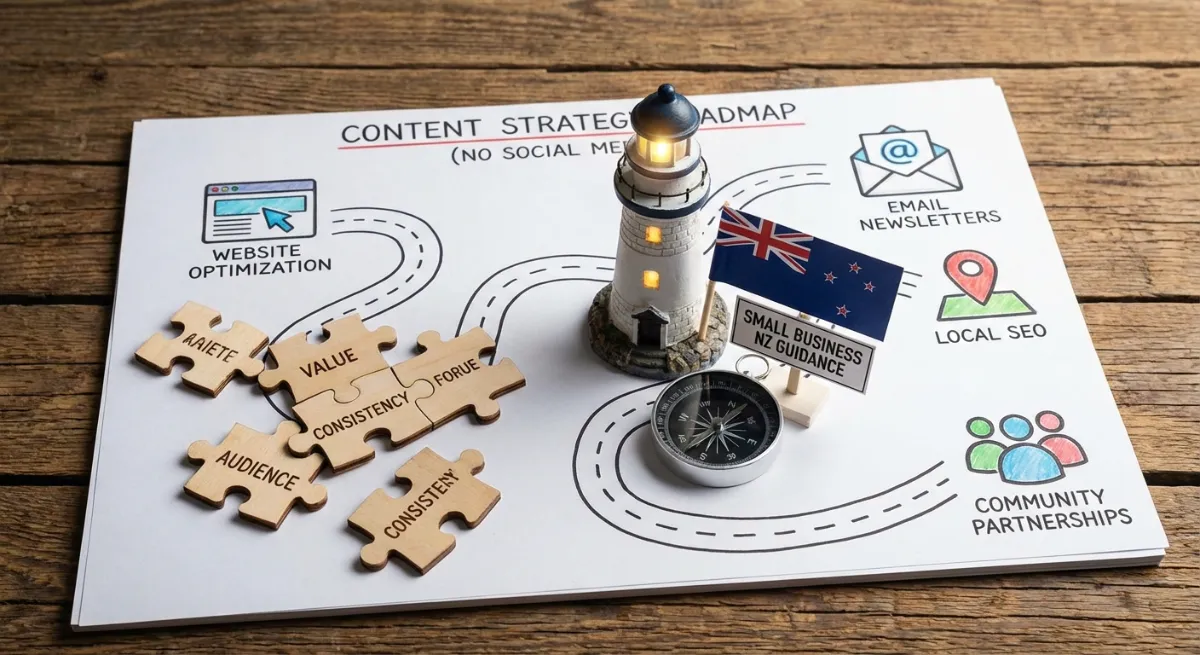
For small businesses in New Zealand looking to thrive in the digital landscape without relying on social media, a robust content strategy isn’t just an option—it’s essential. In a world saturated with fleeting posts and endless feeds, focusing on owned media, such as your website and blog, provides stability, authority, and long-term customer relationships. This expert guide will walk you through building a powerful content strategy tailored for lead generation and engagement, proving that effective digital marketing for small business NZ without social media is not only possible but incredibly effective.
Many New Zealand service businesses, like boutique accounting firm “Whakato Advisors” in Auckland or “Coastal Cleaners” in Wellington, have discovered that a well-crafted content plan can generate consistent, high-quality leads. It’s about providing value, answering questions, and establishing your business as the go-to expert in your niche. Let’s dive into how you can achieve this.
Keyword-Driven Content: The Foundation of Discovery
The first step in any successful content strategy is understanding what your potential customers are actively searching for. This means diving deep into keyword research. For a small business in NZ, this often involves a blend of broad industry terms and highly specific, local long-tail keywords. Think beyond the obvious and consider the problems your services solve.
Tools like Google Keyword Planner (free with a Google account) or even simply observing “People also ask” sections on Google search results can reveal hidden gems. For instance, instead of just targeting “accountant NZ,” a firm might find “tax advice for small business owners NZ” or “GST obligations for startups Wellington” to be far more effective in attracting qualified leads.
- 💡 Identify Your Audience’s Questions: What are the pain points your customers experience? What solutions do they seek?
- 🎯 Research Local & Niche Keywords: Combine your service with geographic modifiers (e.g., “plumber Christchurch emergency”) and specific industry terms (e.g., “commercial refrigeration repair Dunedin”).
- 📈 Analyze Search Volume & Competition: Focus on keywords with a decent search volume but manageable competition to maximize your chances of ranking.
By building content around these specific phrases, you ensure that when someone searches for a solution you provide, your business appears as a relevant and authoritative answer. This precision is key to effective digital marketing for small business NZ without social media.
Blog & Article Creation: Your Digital Storyteller
Your blog is the heart of your content strategy, acting as an educational hub and a constant source of fresh content for search engines. It’s where you can demonstrate your expertise, build trust, and directly address the needs of your audience. Think of it as your virtual salesperson, working 24/7.
When crafting blog posts, consider topics that directly answer the keyword queries you’ve identified. For example, “Bay of Plenty Builders” could write an article titled “Navigating Building Permits in Tauranga: A Guide for Homeowners,” providing immense value while naturally incorporating relevant keywords.
Key Elements of Engaging Blog Posts:
- 📝 Clear Structure: Use an engaging introduction, logical subheadings (H2, H3), bullet points, and a strong conclusion.
- 🔗 SEO Optimization: Integrate your primary and secondary keywords naturally. Include internal links to other relevant pages on your site and external links to reputable sources. Don’t forget compelling meta descriptions and alt text for images.
- 💡 Actionable Advice: Offer practical tips, step-by-step guides, or insightful analyses that readers can immediately apply.
- 🗣️ Call-to-Action (CTA): Every post should guide the reader on what to do next, whether it’s “Download our free checklist,” “Request a quote,” or “Contact us for a consultation.”
Promoting your blog content without social media requires a strategic approach. Consider a well-maintained email newsletter, guest posting on relevant industry blogs or local business directories, and even traditional PR outreach to local media outlets. Sarah Jenkins, owner of “Kiwi Kitchen Renovations” in Hamilton, found great success by partnering with local interior design blogs and featuring her articles in their newsletters, reaching a highly targeted audience.
Website Copywriting: Converting Visitors into Clients
While blog content attracts visitors, your website’s core pages (Home, About Us, Services, Contact) are where you convert them. Effective website copywriting isn’t just about describing what you do; it’s about articulating the benefits you offer and solving your customers’ problems with compelling, clear language.
Every word on your service pages should be crafted with the customer in mind. Instead of “We offer landscaping services,” try “Transform your outdoor space into a tranquil retreat with our bespoke landscaping solutions tailored for Auckland homes.” This shifts the focus from your activity to their desired outcome.
Crafting Conversion-Focused Website Content:
- ✨ Benefit-Oriented Language: Highlight how your services improve your customers’ lives or businesses, not just what they are.
- 🧭 Clear Navigation & Hierarchy: Guide visitors smoothly through your site with intuitive menus and clearly defined sections.
- ✅ Trust Signals: Include testimonials, case studies (like how “Apex Digital Solutions” helped a local NZ brewery double its online sales without social media), and industry certifications.
- CTA Strategic Calls-to-Action: Your CTAs should be prominent, persuasive, and tell the visitor exactly what to do next. Are they ready for a “Free No-Obligation Quote,” or do they need to “Learn More About Our Sustainable Practices”?
A strong Call-to-Action (CTA) is the bridge between interest and action. It needs to be irresistible, clear, and easy to find. For example, instead of a generic “Submit” button, use “Get Your Custom Quote Today” or “Book Your Consultation Now.” Ensure your landing pages are designed to complement these CTAs, providing all the necessary information to encourage conversion. TechFlow Inc., a small IT consultancy in Queenstown, saw a 30% increase in inquiries after redesigning their service pages to feature benefit-driven headlines and prominent, action-oriented CTAs.
Lead Magnet Development: Attracting and Capturing Interest
To capture potential clients who aren’t quite ready to buy, lead magnets are invaluable. These are free, valuable resources offered in exchange for contact information (usually an email address). They’re a cornerstone of successful digital marketing for small business NZ without social media, allowing you to build an audience and nurture leads over time.
Effective Lead Magnet Ideas for NZ Businesses:
- 📚 Exclusive Guides or E-books: “The Small Business Owner’s Guide to NZ Tax Deductions,” or “A Comprehensive Checklist for Starting a Boutique in Nelson.”
- 🛠️ Checklists & Templates: “Website SEO Checklist for NZ Service Businesses” or “Annual Budget Template for Local Cafes.”
- 📊 Local Industry Reports: “Insights into the Canterbury Tourism Market 2024.”
- 🎁 Free Consultations or Assessments: “Get a Free Website Audit for Your NZ Business.”
The key is to offer something genuinely useful and relevant to your target audience’s needs. Promote these lead magnets prominently on your website, within relevant blog posts, and through opt-in forms. Jessica Thompson, founder of “Wellness Hub NZ,” successfully grew her email list by offering a “Mindfulness Journal Template for Busy Kiwis,” which resonated deeply with her target demographic.
Content Calendar: Your Roadmap to Consistency
Consistency is crucial in content marketing. A well-structured content calendar ensures you’re regularly publishing high-quality material, staying organized, and aligning your content with your business goals. It’s your strategic blueprint for the months ahead.
Building Your Content Calendar:
- 📅 Plan Ahead: Map out topics, keywords, and content types (blog posts, website updates, lead magnets) for at least 3-6 months.
- 👤 Assign Roles: Clearly define who is responsible for writing, editing, designing, and publishing each piece of content.
- 💡 Align with Business Cycles: Schedule content to coincide with seasonal demands, product launches, or industry events relevant to your NZ market (e.g., tax season advice, summer holiday promotions).
- 🔄 Be Flexible: While planning is important, remain agile enough to adjust your calendar based on new trends or business priorities.
Using a simple spreadsheet or a project management tool like Trello can help visualize your content flow. The team at “Gardener’s Green” in Hawke’s Bay transformed their sporadic content efforts into a smooth operation after implementing a quarterly content calendar, leading to a steady increase in website traffic and inquiries.
Performance Measurement: Proving Your Content’s Worth
Creating content is only half the battle; measuring its effectiveness is how you ensure your efforts are yielding a return on investment. Without data, you’re guessing. With data, you can refine your strategy and focus on what truly works for your digital marketing for small business NZ without social media.
Key Metrics to Track:
- 📊 Website Traffic: How many visitors are coming to your site and specific content pages? Use Google Analytics.
- ⏱️ Engagement Metrics: Bounce rate (how quickly people leave), time on page, and pages per session. Higher engagement often indicates more valuable content.
- 🔗 SEO Rankings: Are your target keywords improving in search engine results? Google Search Console is vital here.
- 💰 Conversion Rates: How many visitors are completing your desired action (e.g., downloading a lead magnet, filling out a contact form, making a purchase)?
- 📈 Lead Quality: Are the leads generated through your content converting into paying customers at a good rate?
Regularly reviewing these metrics allows you to identify what content resonates most with your audience, which CTAs are most effective, and where improvements can be made. For example, “Peak Performance Coaching” in Otago discovered that their articles featuring local NZ success stories had double the conversion rate of their general motivational posts, prompting them to create more regionally focused content.
Content Engagement Insights (Sample Data)
Understanding which content types drive the most engagement and leads is crucial. Here’s a visual representation of how different content forms might contribute to lead generation:
Blog Posts (Informative)
Lead Magnets (Guides/Checklists)
Website Service Pages (Conversion)
Case Studies/Testimonials
This chart illustrates hypothetical lead generation effectiveness by content type. Actual results may vary based on strategy and audience.
Frequently Asked Questions About Content Strategy
What is content strategy?
Content strategy is a detailed plan for creating, publishing, and managing useful and usable content. It defines your goals, target audience, and how content will help achieve business objectives, focusing on topics, formats, and channels. For small businesses in NZ, it ensures every piece of content contributes to lead generation and brand authority, particularly when operating without social media as a primary channel.
Why is content important for SEO?
Content is fundamental to SEO because search engines like Google are designed to provide the most relevant and authoritative answers to user queries. High-quality, keyword-optimized content signals to search engines that your website is a valuable resource. The more comprehensive, engaging, and relevant your content, the higher your chances of ranking well, driving organic traffic, and attracting potential customers actively searching for your services.
Can I write my own content?
Absolutely! Many small business owners in NZ successfully write their own content. The key is to understand your audience, research keywords, and dedicate time to crafting clear, valuable, and consistent material. While professional writers can bring a polished touch, your unique voice and industry expertise are invaluable. If time is a constraint, consider focusing on key areas like foundational website copy and a few pillar blog posts, gradually expanding as you gain confidence or resources.
Conclusion: Your Path to Digital Success Without Social Media
Building a robust content strategy for your New Zealand small business doesn’t require a social media presence. By focusing on keyword-driven content, engaging blog posts, high-converting website copy, effective lead magnets, a consistent content calendar, and diligent performance measurement, you can build a powerful digital footprint that attracts, engages, and converts your ideal clients. Businesses like “Mana Marina Services” in Nelson and “Alpine Adventures Tours” in Queenstown have successfully leveraged this approach to establish strong online presences and generate consistent inquiries.
Embrace the power of owned content. It’s a long-term investment that builds trust, authority, and a sustainable pipeline of leads, proving that smart digital marketing for small business NZ without social media is not just viable, but a highly effective route to growth.
Editorial Team
Expert insights for International.